Loading Image Dc Comics Girl Heroes Baby Cartoon

A superhero or superheroine is a stock character that possesses superpowers, abilities beyond those of ordinary people, and fits the role of the hero, typically using his or her powers to help the globe become a amend place, or dedicating themselves to protecting the public and fighting crime. Superhero fiction is the genre of fiction that is centered on such characters,[1] especially, since the 1930s, in American comic books (and afterward in Hollywood films, film serials, television and video games), likewise as in Japanese media (including kamishibai, tokusatsu, manga, anime and video games).
Superheroes come from a wide array of unlike backgrounds and origins. Some superheroes (for example, Batman and Iron Human being) derive their status from advanced technology they create and utilise, while others (such equally Superman and Spider-Human) possess non-human or superhuman biology or study and practice magic to accomplish their abilities (such as Zatanna and Dr. Strange).[2] [iii] [4] While the Dictionary.com definition of "superhero" is "a effigy, peculiarly in a comic strip or cartoon, endowed with superhuman powers and usually portrayed as fighting evil or crime",[v] the longstanding Merriam-Webster dictionary gives the definition equally "a fictional hero having boggling or superhuman powers; also: an uncommonly skillful or successful person."[vi] Terms such as masked criminal offense fighters, costumed adventurers or masked vigilantes are sometimes used to refer to characters such as the Spirit, who may not be explicitly referred to as superheroes but yet share like traits.
Some superheroes use their powers to assist fight daily criminal offence while also combating threats against humanity from supervillains, who are their criminal counterparts. Often at least 1 of these supervillains volition be the superhero's archenemy or nemesis. Some popular supervillains go recurring characters in their own correct. Long-running superheroes and superheroines such as Batman, Superman, Wonder Woman, Spider-Man, Captain America, and Atomic number 26 Man have a rogues gallery of many such villains.
History
1900s–1939
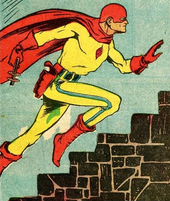
The give-and-take superhero dates back to 1899.[seven] Antecedents of the archetype include such mythologic characters like Gilgamesh, Hanuman, Perseus, Odysseus, David, and demigods like Heracles,[8] [9] likewise as folkloric heroes equally Robin Hood, who adventured in distinctive article of clothing.[ten] Existent life inspirations behind costumed superheroes can exist traced back to the "masked vigilantes" of the American Sometime West such as the San Diego Vigilantes[eleven] and the Bald Knobbers[12] who fought and killed outlaws while wearing masks.[13]
The 1903 British play The Ruby-red Pimpernel and its spinoffs popularized the idea of a masked avenger and the superhero trope of a secret identity.[ten] Shortly subsequently, masked and costumed lurid fiction characters such as Jimmie Dale/the Gray Seal (1914), Zorro (1919), Buck Rogers (1928), The Shadow (1930), Flash Gordon (1934), and comic strip heroes, such as the Phantom (1936) began actualization, as did non-costumed characters with super strength, including the comic-strip characters Patoruzú (1928) and Popeye (1929) and novelist Philip Wylie's character Hugo Danner (1930).[14] Another early example was Sarutobi Sasuke, a Japanese superhero ninja from children's novels in the 1910s;[15] [16] [17] past 1914, he had a number of superhuman powers and abilities.[15] In August 1937, in a letter of the alphabet column of the lurid mag Thrilling Wonder Stories, the word superhero was used to define the title character of the comic strip Zarnak by Max Plaisted.[18] [19]
In the 1930s, the trends converged in some of the earliest superpowered costumed heroes, such as Japan's Ōgon Bat (1931) and Prince of Gamma (early 1930s), who first appeared in kamishibai (a kind of hybrid media combining pictures with live storytelling),[20] [21] Mandrake the Sorcerer (1934),[22] [23] [24] Olga Mesmer (1937)[25] and and then Superman (1938) and Helm Marvel (1939) at the get-go of the Golden Age of Comic Books. The precise era of the Aureate Age of Comic Books is disputed, though virtually agree that it was started with the launch of Superman in 1938.[26] Superman has remained one of the most recognizable superheroes,[26] and his success spawned a new archetype of characters with underground identities and superhuman powers.[27] [28] [29] At the end of the decade, in 1939, Batman was created by Bob Kane and Beak Finger.
1940s

During the 1940s there were many superheroes: The Flash, Greenish Lantern and Blue Beetle debuted in this era. This era saw the debut of one of the primeval female superheroes, writer-artist Fletcher Hanks's character Fantomah, an ageless ancient Egyptian adult female in the modernistic day who could transform into a skull-faced animate being with superpowers to fight evil; she debuted in Fiction House'due south Jungle Comic #2 (Feb. 1940), credited to the pseudonymous "Barclay Flagg".[30] [31] The Invisible Cerise O'Neil, a not-costumed character who fought crime and wartime saboteurs using the superpower of invisibility created past Russell Stamm, would debut in the eponymous syndicated paper comic strip a few months afterward on June 3, 1940.[32]
In 1940, Maximo the Amazing Superman debut in Big Piddling Book serial, by Russell R. Winterbotham (text), Henry E. Vallely and Erwin L. Hess (art).[33] [34]
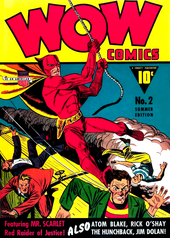
Captain America also appeared for the offset time in print in December 1940, a year prior to the assault on Pearl Harbor by the Japanese government, when America was all the same in isolationism. Created by Joe Simon and Jack Kirby, the superhero was the physical apotheosis of the American spirit during World State of war Ii.
One superpowered character was portrayed as an antiheroine, a rarity for its fourth dimension: the Black Widow, a costumed emissary of Satan who killed evildoers in order to send them to Hell—debuted in Mystic Comics #4 (Aug. 1940), from Timely Comics, the 1940s predecessor of Marvel Comics. Most of the other female costumed crime-fighters during this era lacked superpowers. Notable characters include The Woman in Ruby,[35] [36] introduced in Standard Comics' Thrilling Comics #2 (March 1940); Lady Luck, debuting in the Sunday-paper comic-volume insert The Spirit Section June ii, 1940; the comedic character Red Tornado, debuting in All-American Comics #20 (Nov 1940); Miss Fury,[37] debuting in the eponymous comic strip past female cartoonist Tarpé Mills on April 6, 1941; the Phantom Lady, introduced in Quality Comics Police Comics #1 (Aug. 1941); the Blackness Cat,[38] [39] introduced in Harvey Comics' Pocket Comics #1 (as well Aug. 1941); and the Black Canary, introduced in Flash Comics #86 (Aug. 1947) as a supporting graphic symbol.[twoscore] The nigh iconic comic book superheroine, who debuted during the Gold Age, is Wonder Adult female.[41] Modeled from the myth of the Amazons of Greek mythology, she was created past psychologist William Moulton Marston, with help and inspiration from his wife Elizabeth and their common lover Olive Byrne.[42] [43] Wonder Woman's commencement appearance was in All Star Comics #8 (December. 1941), published by All-American Publications, i of two companies that would merge to form DC Comics in 1944.
Pérák was an urban legend originating from the city of Prague during the German occupation of Czechoslovakia in the midst of World War Ii. In the decades following the war, Pérák has also been portrayed every bit the only Czech superhero in moving picture and comics.
1950s
In 1952, Osamu Tezuka's manga Tetsuwan Atom, more than popularly known in the West as Astro Male child, was published. The series focused upon a robot boy built by a scientist to replace his deceased son. Being built from an incomplete robot originally intended for military purposes Astro Boy possessed amazing powers such as flight through thrusters in his anxiety and the incredible mechanical strength of his limbs.
The 1950s saw the Silvery Age of Comics. During this era DC introduced the likes of Batwoman in 1956, Supergirl[ disambiguation needed ], Miss Arrowette, and Bat-Girl; all female derivatives of established male superheroes.
In 1957 Japan, Shintoho produced the showtime film serial featuring the superhero grapheme Super Giant, signaling a shift in Japanese popular culture towards tokusatsu masked superheroes over kaiju behemothic monsters. Forth with Astro Boy, the Super Giant serials had a profound consequence on Japanese television. 1958 saw the debut of superhero Moonlight Mask on Japanese television. It was the first of numerous televised superhero dramas that would make up the tokusatsu superhero genre.[44] Created by Kōhan Kawauchi, he followed-up its success with the tokusatsu superhero shows Seven Color Mask (1959) and Messenger of Allah (1960), both starring a young Sonny Chiba.
1960s
It is arguable that the Marvel Comics teams of the early 1960s brought the biggest assortment of superheroes ever at i fourth dimension into permanent publication, the likes of Spider-Man (1962), The Hulk, Atomic number 26 Man, Daredevil, Nick Fury, The Mighty Thor, The Avengers (featuring a rebooted Captain America, Thor, Hulk, Ant-Man, Quicksilver), and many others were given their ain monthly titles.
Typically the superhero super groups featured at least ane (and oft the merely) female person fellow member, much similar DC's flagship superhero team the Justice League of America (whose initial roster included Wonder Adult female as the token female); examples include the Fantastic Four'due south Invisible Girl, the 10-Men'south Jean Gray (originally known as Marvel Daughter), the Avengers' Wasp, and the Brotherhood of Mutants' Scarlet Witch (who later on joined the Avengers) with her brother, Quicksilver.
In 1963, Astro Male child was adjusted into a highly influential anime goggle box series. Phantom Agents in 1964 focused on ninjas working for the Japanese authorities and would be the foundation for Sentai-type series. 1966 saw the debut of sci-fi/horror serial Ultra Q created by Eiji Tsuburaya this would eventually atomic number 82 on to the sequel Ultraman, spawning a successful franchise which pioneered the Kyodai Hero subgenre where the superheroes would be as big as behemothic monsters (kaiju) that they fought.
The kaiju monster Godzilla, originally a villain, began being portrayed every bit a radioactive superhero in the Godzilla films,[45] starting with Ghidorah, the Iii-Headed Monster (1964).[46] By the 1970s, Godzilla came to exist viewed as a superhero, with the magazine King of the Monsters in 1977 describing Godzilla as "Superhero of the '70s."[47]
1970s
In 1971, Kamen Rider launched the "Henshin Smash" on Japanese television in the early on 1970s, greatly impacting the tokusatsu superhero genre in Nihon.[48] In 1972, the Science Ninja Team Gatchaman anime debuted, which built upon the superhero squad thought of the live-action Phantom Agents as well as introducing different colors for team members and special vehicles to back up them, said vehicles could also combine into a larger one. Another of import event was the debut of Mazinger Z by Become Nagai, creating the Super Robot genre. Go Nagai too wrote the manga Cutey Dear in 1973; although the Magical Girl genre already existed, Nagai'due south manga introduced Transformation sequences that would go a staple of Magical Girl media.
The 1970s would meet more anti-heroes introduced into Superhero fiction such examples included the debut of Shotaro Ishinomori's Skull Man (the basis for his afterward Kamen Rider) in 1970, Go Nagai'south Devilman in 1972 and Gerry Conway and John Romita'south Punisher in 1974.
The dark Skull Man manga would later get a goggle box adaptation and underwent desperate changes. The grapheme was redesigned to resemble a grasshopper, becoming the renowned start masked hero of the Kamen Rider series. Kamen Rider is a motorcycle riding hero in an insect-like costume, who shouts Henshin (Metamorphosis) to don his costume and gain superhuman powers.
The ideas of second-wave feminism, which spread through the 1960s into the 1970s, profoundly influenced the way comic volume companies would depict likewise as market their female characters: Wonder Woman was for a time revamped as a mod-dressing martial artist straight inspired by the Emma Skin character from the British television series The Avengers (no relation to the superhero team of the same name),[49] but after reverted to Marston'due south original concept later the editors of Ms. magazine publicly disapproved of the character being depowered and without her traditional costume;[50] Supergirl was moved from being a secondary feature on Activeness Comics to headline Hazard Comics in 1969; the Lady Liberators appeared in an issue of The Avengers as a group of mind-controlled superheroines led by Valkyrie (really a disguised supervillainess) and were meant to be a caricatured parody of feminist activists;[51] and Jean Greyness became the embodiment of a cosmic being known as the Phoenix Force with seemingly unlimited ability in the belatedly 1970s, a stark contrast from her delineation as the weakest fellow member of her team a decade agone.
Both major publishers began introducing new superheroines with a more distinct feminist theme as office of their origin stories or character development. Examples include Large Barda, Ability Girl, and the Huntress by DC comics; and from Curiosity, the 2nd Blackness Widow, Shanna the She-Devil, and The True cat.[52] Female supporting characters who were successful professionals or concur positions of authorisation in their own right also debuted in the pages of several popular superhero titles from the tardily 1950s onward: Hal Jordan's love interest Ballad Ferris was introduced as the Vice-President of Ferris Aircraft and later took over the company from her father; Medusa, who was first introduced in the Fantastic Iv serial, is a member of the Inhuman Majestic Family and a prominent statesperson within her people's quasi-feudal society; and Ballad Danvers, a decorated officeholder in the U.s. Air Strength who would get a costumed superhero herself years subsequently.
In 1975 Shotaro Ishinomori's Himitsu Sentai Gorenger debuted on what is now Television set Asahi, it brought the concepts of multi-colored teams and supporting vehicles that debuted in Gatchaman into live-activity, and began the Super Sentai franchise (later adjusted into the American Power Rangers series in the 1990s). In 1978, Toei adapted Spider-Human being into a alive-action Japanese television series. In this continuity, Spider-Man had a vehicle called Marveller that could transform into a giant and powerful robot chosen Leopardon, this idea would be carried over to Toei's Battle Fever J (likewise co-produced with Marvel) and now multi-colored teams not only had support vehicles but giant robots to fight giant monsters with.
1980–present
In subsequent decades, popular characters similar Dazzler, She-Hulk, Elektra, Catwoman, Witchblade, Spider-Girl, Batgirl and the Birds of Casualty became stars of long-running eponymous titles. Female person characters began assuming leadership roles in many ensemble superhero teams; the Uncanny X-Men series and its related spin-off titles in detail take included many female characters in pivotal roles since the 1970s.[53] Volume four of the X-Men comic book series featured an all-female person team as part of the Marvel At present! branding initiative in 2013.[54] Superpowered female characters like Buffy the Vampire Slayer[55] and Darna[56] [57] have a tremendous influence on popular culture in their respective countries of origin.
With more than and more anime, manga and tokusatsu being translated or adjusted, Western audiences were beginning to experience the Japanese styles of superhero fiction more than they were able to before. Saban's Mighty Morphin Power Rangers, an adaptation of Zyuranger, created a multimedia franchise that used footage from Super Sentai.[58] Internationally, the Japanese comic book character, Crewman Moon, is recognized equally one of the nigh important and popular female superheroes always created.[59] [60] [61] [62] [63]
Trademark status
Most dictionary definitions and common usages of the term are generic and not limited to the characters of whatsoever item company or companies.[7] [64]
Nevertheless, variations on the term "Super Hero" or "Superhero" are jointly claimed past DC Comics and Curiosity Comics as trademarks. Registrations of "Super Hero" marks accept been maintained by DC and Marvel since the 1960s, including U.S. Trademark Serial Nos. 72243225 and 73222079.[65] In 2009, the term "Super Heroes" was registered as a typography-independent "descriptive" US trademark co-owned by DC and Marvel.[66] Both DC Comics and Marvel Comics have been bulldogged in protecting their rights in the "Super Hero" trademarks in jurisdictions where the registrations are in force, including the United States, the United Kingdom, and Australia, and including in respect of diverse goods and services falling exterior comic volume publications.[67]
Critics in the legal community dispute whether the "Super Hero" marks meet the legal standard for trademark protection in the United States: distinctive designation of a single source of a production or service. Controversy exists over each element of that standard: whether "Super Hero" is distinctive rather than generic, whether "Super Hero" designates a source of products or services, and whether DC and Marvel jointly stand for a single source.[68] Some critics farther characterize the marks as a misuse of trademark police to chill competition.[69] To date, aside from a failed trademark removal action brought in 2016 against DC Comics' and Marvel Comics' United kingdom registration, no dispute involving the trademark "Super Hero" has e'er been to trial or hearing.[67]
Minority superheroes
In keeping with their origins as representing the archetypical hero stock character in 1930s American comics, superheroes are predominantly depicted equally White American center- or upper-course immature adult males and females who are typically tall, athletic, educated, physically bonny and in perfect health. Start in the 1960s with the civil rights movement in the United States, and increasingly with the rise concern over political correctness in the 1980s, superhero fiction centered on cultural, ethnic, national, racial and language minority groups (from the perspective of The states demographics) began to be produced. This began with delineation of black superheroes in the 1960s, followed in the 1970s with a number of other ethnic-minority superheroes.[lxx] In keeping with the political mood of the time, cultural diversity and inclusivism would be an important part of superhero groups starting from the 1980s. In the 1990s, this was further augmented past the offset depictions of superheroes as homosexual. In 2017, Sign Gene emerged, the first grouping of deaf superheroes with superpowers through the utilize of sign language.[71]
Female person superheroes and villains
Female super heroes—and villains—have been around since the early years of comic books dating dorsum to the 1940s.[72] The representation of women in comic books has been questioned in the past decade following the rise of comic book characters in the film industry (Marvel/DC movies). Women are presented differently than their male person counterparts, typically wearing revealing habiliment that showcases their curves and cleavage and showing a lot of skin in some cases.[73] [74] Heroes like Power Girl and Wonder Woman are portrayed wearing little wear and showing cleavage.[73] [74] Ability Daughter is portrayed as wearing a suit not unlike the swimsuits in the T.5. show Baywatch. The sexualization of women in comic books tin be explained mainly by the fact that the bulk of writers are male.[74] Not but are the writers more often than not male person, but the audience is more often than not male person as well.[75] [74] Therefore, writers are designing characters to appeal to a mostly male audition.[75] [76] The super hero characters illustrate a sociological idea chosen the "male gaze" which is media created from the viewpoint of a normative heterosexual male person.[76] [77] The female person characters in comic books are used to satisfy male desire for the "ideal" woman (pocket-sized waist, big breasts, toned, athletic torso).[76] [78] [74] These characters have god-like power, only the near easily identifiable feature is their hyper sexualized bodies as they are designed to be sexually pleasing to the hypothetical heteronormative male audience.[73] [77] [78] [74]
Villains, such as Harley Quinn and Poisonous substance Ivy, use their sexuality to take reward of their male victims.[74] In the film versions of these characters, their sexuality and seductive methods are highlighted. Poison Ivy uses seduction through poison to take over the minds of her victims as seen in the 1997 pic Batman and Robin. Harley Quinn in 2016's Suicide Team uses her sexuality to her advantage, acting in a promiscuous manner.
Through the overdeveloped bodies of the heroes or the seductive mannerisms of the villains, women in comic books are used as subordinates to their male counterparts, regardless of their forcefulness or power.[79] In 2017's Wonder Adult female, she had the ability of a god, but was notwithstanding drawn to a much weaker, mortal male person character.[77] This can exist explained past the sociological concept "feminine atoning," which reinforces a adult female'south femininity to account for her masculine attributes (strength, individualism, toughness, aggressiveness, bravery).[77] Women in comic books are considered to be misrepresented due to being created by men, for men.[76] [78]
The Hawkeye Initiative is a website satirizing the sexualized portrayal of women in comics by recreating the aforementioned poses using male person superheroes, especially Marvel'south Eagle.[fourscore] [81] [82]
Ethnic and religious minorities
In 1966, Marvel introduced the Blackness Panther, an African monarch who became the commencement non-caricatured black superhero.[83] The beginning African-American superhero, the Falcon, followed in 1969, and three years after, Luke Cage, a self-styled "hero-for-hire", became the starting time black superhero to star in his own series. In 1989, the Monica Rambeau incarnation of Captain Marvel was the first female black superhero from a major publisher to get her own title in a special one-shot issue. In 1971, Red Wolf became the first Native American in the superheroic tradition to headline a series.[84] In 1973, Shang-Chi became the beginning prominent Asian superhero to star in an American comic book (Kato had been a secondary grapheme of the Green Hornet media franchise series since its inception in the 1930s.[85]). Kitty Pryde, a member of the X-Men, was an openly Jewish superhero in mainstream American comic books every bit early on as 1978.[86]
Comic-book companies were in the early stages of cultural expansion and many of these characters played to specific stereotypes; Cage and many of his contemporaries often employed lingo similar to that of blaxploitation films, Native Americans were often associated with shamanism and wild animals, and Asian Americans were often portrayed as kung fu martial artists. Subsequent minority heroes, such as the X-Men's Storm and the Teen Titans' Cyborg avoided such conventions; they were both function of ensemble teams, which became increasingly diverse in subsequent years. The X-Men, in particular, were revived in 1975 with a line-up of characters drawn from several nations, including the Kenyan Tempest, German Nightcrawler, Soviet/Russian Colossus, Irish Banshee, and Japanese Sunfire. In 1993, Milestone Comics, an African-American-endemic media/publishing company entered into a publishing agreement with DC Comics that allowed them to introduce a line of comics that included characters of many ethnic minorities. Milestone's initial run lasted 4 years, during which it introduced Static, a graphic symbol adapted into the WB Network animated series Static Daze.
In addition to the creation of new minority heroes, publishers take filled the identities and roles of once-Caucasian heroes with new characters from minority backgrounds. The African-American John Stewart appeared in the 1970s equally an alternating for Globe'southward Green Lantern Hal Jordan, and would become a regular member of the Green Lantern Corps from the 1980s onward. The creators of the 2000s-era Justice League animated series selected Stewart as the testify's Light-green Lantern. In the Ultimate Marvel universe, Miles Morales, a youth of Puerto Rican and African-American ancestry who was also bitten by a genetically-contradistinct spider, debuted as the new Spider-Man afterwards the credible death of the original Spider-Man, Peter Parker. Kamala Khan, a Pakistani-American Muslim teenager who is revealed to have Inhuman lineage after her shapeshifting powers manifested, takes on the identity of Ms. Marvel in 2014 after Ballad Danvers had become Helm Marvel. Her self-titled comic book series became a cultural phenomenon, with all-encompassing media coverage by CNN, the New York Times and The Colbert Report, and embraced by anti-Islamophobia campaigners in San Francisco who plastered over anti-Muslim autobus adverts with Kamala stickers.[87] Other such successor-heroes of color include James "Rhodey" Rhodes every bit Fe Man and to a bottom extent Riri "Ironheart" Williams, Ryan Choi as the Atom, Jaime Reyes as Blue Beetle and Amadeus Cho every bit Hulk.
Certain established characters accept had their ethnicity changed when adjusted to another continuity or media. A notable instance is Nick Fury, who is reinterpreted as African-American both in the Ultimate Marvel likewise equally the Marvel Cinematic Universe continuities.
Sexual orientation and gender identity
In 1992, Marvel revealed that Northstar, a member of the Canadian mutant superhero squad Blastoff Flight, was homosexual, after years of implication.[88] This ended a long-continuing editorial mandate that there would be no homosexual characters in Marvel comics.[89] Although some minor secondary characters in DC Comics' mature-audience 1980s miniseries Watchmen were gay, and the reformed supervillain Pied Piper came out to Wally West in an issue of The Flash in 1991, Northstar is considered to be the starting time openly gay superhero actualization in mainstream comic books. From the mid-2000s onward, several established Marvel and DC comics characters (or a variant version of the pre-existing graphic symbol) were outed or reintroduced as LGBT individuals past both publishers. Examples include the Mikaal Tomas incarnation of Starman in 1998; Colossus in the Ultimate X-Men series; Renee Montoya in DC's Gotham Fundamental series in 2003; the Kate Kane incarnation of Batwoman in 2006; Rictor and Shatterstar in an issue of X-Factor in 2009; the Golden Age Green Lantern Alan Scott is reimagined equally openly gay following The New 52 reboot in 2011;[90] [91] and in 2015, a younger fourth dimension displaced version of Iceman in an event of All-New 10-Men.[92]
Many new openly gay, lesbian and bisexual characters have since emerged in superhero fiction, such as Gen¹³'s Rainmaker, Apollo and Midnighter of The Authorisation, and Wiccan and Hulkling of the Young Avengers. Notable transgender or gender bending characters are fewer in number past comparison: the change ego of superheroine Zsazsa Zaturnnah, a seminal character in Philippine pop culture,[93] is an effeminate gay man who transforms into a female superhuman after ingesting a magical stone. Desire from Neil Gaiman's The Sandman serial, Cloud from Defenders, and Xavin from the Runaways are all characters who could (and often) change their gender at will. Alysia Yeoh, a supporting character created by author Gail Simone for the Batgirl ongoing series published by DC Comics, received substantial media attention in 2011 for beingness the first major transgender character written in a gimmicky context in a mainstream American comic book.[94]
The Sailor Moon series is known for featuring a substantial number of openly LGBT characters since its inception, as Nihon take traditionally been more than open up about portraying homosexuality in its children'due south media compared to many countries in the Westward.[95] [96] Sure characters who are presented as homosexual or transgender in ane continuity may non be presented as such in others, particularly with dubbed versions made for international release.[97]
An animated short The Ambiguously Gay Duo parodies comic book superheros and features Ace and Gary (Stephen Colbert, Steve Carell). It originated on The Dana Carvey Show so moved to Saturday Dark Alive.
Language minority
In 2017, Pluin introduced Sign Gene, a flick featuring a group of deaf superheroes whose powers derive from their use of sign language. The film was produced by and with deafened people and deals with Deaf civilisation, history and language.[71] [98] [99]
Subtypes
- List of child superheroes
- List of beast superheroes
- Listing of metahumans in DC Comics
See as well
- Category:Parody superheroes
- Real-life superhero
- List of superhero debuts
- List of superhero teams and groups
- Latino Superheros
References
- ^ "Definition of SUPERHERO". www.merriam-webster.com . Retrieved September 7, 2020.
- ^ Niccum, John (March 17, 2006). "'V for Vendetta' is S for Destructive". Lawrence Periodical-World. Lawrence, Kansas. Archived from the original on November xiv, 2013.
- ^ Gesh, Lois H.; Weinberg, Robert (2002). "The Dark Knight: Batman: A NonSuper Superhero" (PDF). The Scientific discipline of Superheroes. John Wiley & Sons. ISBN978-0-471-02460-6. Archived (PDF) from the original on Nov six, 2015.
- ^ Lovece, Frank (July 16, 2008). "The Dark Knight". (motion-picture show review) Film Journal International. Archived from the original on November 7, 2014. Retrieved February 5, 2009.
Batman himself is an anomaly as one of the few superheroes without superpowers…
- ^ "Superhero | Define Superhero at Dictionary.com". Dictionary.reference.com. Archived from the original on Nov 13, 2014. Retrieved March 26, 2016.
- ^ "Superhero | Definition of Superhero past Merriam-Webster". Merriam-webster.com. March 22, 2016. Retrieved March 26, 2016.
- ^ a b "Superhero - Definition and More from the Free Merriam-Webster Dictionary". Archived from the original on Oct 8, 2021. Retrieved October 12, 2021.
- ^ Coogan, Peter (July 25, 2006). Superhero: The Hush-hush Origin of a Genre. Austin, Texas: MonkeyBrain Books. ISBNone-932265-eighteen-X.
- ^ "Roger Ebert. Roger Ebert'south review of [[Watchmen (film)|Watchmen]] rogerebert.com; March 4, 2009". Archived from the original on February nine, 2013. Retrieved Oct 4, 2021.
- ^ a b Packer, Sharon (2009). Superheroes and Superegos: Analyzing the Minds Backside the Masks. Greenwood Publishing Grouping. p. 52. ISBN978-0313355363.
- ^ Crawford, Richard (April 30, 1992). "The Wild Due west : Executions Staged by Vigilantes Marred Justice in the 1880s". Los Angeles Times. April 30, 1992
- ^ Sokol, Tony (January 20, 2019). "The Punisher and The Dark Myth of the Real Life Vigilante". Den of Geek. January xx, 2019
- ^ Gavaler, Chris. On the Origin of Superheroes: From the Big Blindside to Action Comics No. one. University Of Iowa Press; 1 edition (Nov 1, 2015). p. 132. ISBN 978-1609383817
- ^ Lovece, Frank (November 11, 2013). "Superheroes Go the American Way on PBS". Newsday. New York / Long Island. Archived from the original on February 22, 2014. Retrieved November 15, 2013.
- ^ a b Torrance, Richard (2005). "Literacy and Literature in Osaka, 1890-1940". The Journal of Japanese Studies. Gild for Japanese Studies (31): 56.
Sarutobi Sasuke precipitated a "ninja boom" among the young throughout the country. Sarutobi is an adolescent superhero who, in add-on to his ability to chant incantations, appear and disappear at will, and spring to the tiptop of the highest tree, tin can hear whispered conversations hundreds of yards abroad, is superhumanly strong, can ride on clouds, is able to conjure water, fire and current of air besides as transform himself into other people and animals.
- ^ "A primer on the history of "NINJA"". Vintage Ninja . Retrieved November 20, 2011.
- ^ Yoshimoto, Mitsuhiro (2000). Kurosawa: Film Studies and Japanese Cinema. Duke University Press. p. 417. ISBN978-0-8223-2519-two.
- ^ Davin, Eric Leif (2006). Partners in Wonder: Women and the Nascency of Scientific discipline Fiction, 1926-1965. Lexington Books. ISBN978-0-7391-1267-0.
- ^ "Superhero". Historical Lexicon of Science Fiction . Retrieved March 8, 2022.
{{cite spider web}}: CS1 maint: url-status (link) - ^ Davisson, Zack (December nineteen, 2010). "The Beginning Superhero – The Golden Bat?". ComicsBulletin.com. Archived from the original on November 9, 2014. Retrieved November eighteen, 2014.
- ^ Bradner, Liesl (Nov 29, 2009). "The superheroes of Japan who predated Superman and Batman". Los Angeles Times. Archived from the original on January 5, 2014. Retrieved November 18, 2014.
- ^ "Who was the offset superhero?". Archived from the original on March 30, 2012. Retrieved March 26, 2016.
- ^ "Don Markstein'due south Toonopedia: The Adventures of Patsy". Toonopedia.com. March 11, 1935. Retrieved March 26, 2016.
- ^ "First superhero e'er in the earth. Mandrake the Magician Lee Falk Popeye the Crewman Man Superman". Thelongestlistofthelongeststuffatthelongestdomainnameatlonglast.com. February 17, 1936. Archived from the original on April 6, 2016. Retrieved March 26, 2016.
- ^ Glen Weldon; Michael Kantor. Superheroes!:Capes cowls and the creation of comic book culture. p. 87.
- ^ a b "The Aureate Age Of Comics". www.pbs.org. Retrieved Jan 11, 2018.
- ^ Burke, Liam (2008). Superhero Movies. Harpenden, United kingdom of great britain and northern ireland: Oldcastle Books. ISBN978-1842432754.
If Superman tin be credited with the creation of the superhero archetype, and so Batman should be recognised for its refinement.
- ^ Lee, Stan (2013). "The Two Superhero Archetypes". Stan Lee's How to Draw Superheroes. Watson-Guptill. p. 38. ISBN978-0823098453.
- ^ LoCicero, Don (2007). Superheroes and Gods: A Comparative Study from Babylonia to Batman. McFarland & Company. p. 7. ISBN978-0786431847.
[T]he superhero is a concept [...] an classic residing in the homo psyche.
- ^ Markstein, Don. "The Black Widow". Don Markstein's Toonopedia. Archived from the original on April fifteen, 2012. Retrieved July 26, 2013.
Fantomah was the outset female grapheme in comics to use boggling powers in combatting evil. The Woman in Red was the first to wearable a flashy costume and maintain a dual identity while doing so. On the other hand, The Black Widow was the first to do both.
- ^ Fantomah, Mystery Woman of the Jungle at Don Markstein's Toonopedia. Archived from the original on January 29, 2015.
- ^ Heintjes, Tom (May 11, 2012). "Not Seen but not Forgotten: The Invisible Scarlet O'Neil". Hogan's Alley. No. 17. Archived from the original on June 12, 2013. Retrieved January 16, 2013.
- ^ Schelly, Bill (June eighteen, 2013). The Best of Alter Ego Volume 2. Alter Ego. TwoMorrows Publishing. ISBN978-1-60549-048-nine.
- ^ Carper, Steve (June 27, 2019). Robots in American Popular Culture. McFarland. ISBN978-1-4766-3505-7.
- ^ "Don Markstein's Toonopedia: The Adult female in Ruby-red". Toonopedia.com. Retrieved March 26, 2016.
- ^ "GCD :: Issue :: Thrilling Comics #v1#2 (2)". Comics.org. Jan 11, 1940. Retrieved March 26, 2016.
- ^ "Don Markstein's Toonopedia: Miss Fury". Toonopedia.com. Apr 6, 1941. Archived from the original on Apr 9, 2012. Retrieved March 26, 2016.
- ^ "Don Markstein'south Toonopedia: The Black Cat". Toonopedia.com. Retrieved March 26, 2016.
- ^ "GCD :: Consequence :: Pocket Comics #ane". Comics.org. Retrieved March 26, 2016.
- ^ Jim Amash & Eric Nolen-Weathington, (2010), Carmine Infantino: Penciler, Publisher, Provocateur p.30-32
- ^ Curtis M. Wong (August 19, 2015). "Wonder Adult female Officiates Her First Gay Wedding". Huffingtonpost.com. Retrieved March 27, 2016.
- ^ Lamb, Marguerite (Fall 2001). "Who Was Wonder Woman?". Bostonia. Archived from the original on January xix, 2007.
- ^ Malcolm, Andrew H. (February 18, 1992). "OUR TOWNS - She's Behind the Friction match For That Man of Steel - NYTimes.com". New York Times . Retrieved March 26, 2016.
- ^ Japan Pop!: Inside the World of Japanese Popular Culture, p. 262 ISBN 0-7656-0560-0
- ^ Lankes, Kevin (June 22, 2014). "Godzilla's Secret History". Huffington Post . Retrieved March 19, 2018.
- ^ Grebey, James (May 28, 2019). "The history of Ghidorah, Godzilla'southward rival for the title of King of the Monsters". Syfy Wire. NBCUniversal. Retrieved May 27, 2020.
- ^ Glut, Donald F. (2001). "Godzilla, Saurian Superhero". Jurassic Classics: A Collection of Saurian Essays and Mesozoic Musings. McFarland & Company. p. 225. ISBN978-0-7864-6246-9.
- ^ Takeshobo, ed. (November 30, 1995). "BonusColumn「変身ブーム到来!!」" [Bonus Column 'The Henshin Blast Arrives!']. 超人画報 国産架空ヒーロー四十年の歩み [The Super Heroes Chronicles: The History of Japanese Fantastic Televisions, Movies and Videos, 1957-1995] (in Japanese). Takeshobo. p. 85. ISBN4-88475-874-9. C0076.
- ^ "Nosotros were all in love with Diana Rigg and that bear witness she was on." Mike Sekowsky, quoted in Les Daniels, Wonder Woman: The Consummate History (Chronicle, 2004), p. 129.
- ^ Wonder Woman Wears Pants: Wonder Woman, Feminism and the 1972 "Women's Lib" Effect, by Ann Matsuuchi [ permanent dead link ] , in Colloquy: text theory critique, no.24 (2012); archived at Monash University
- ^ W. Wright, Bradford (2001). Comic Book Nation: The Transformation of Youth Civilization in America . United states of america: The Johns Hopkins University Press. p. 250. ISBN0-8018-6514-Ten . Retrieved December 29, 2014.
lady liberators.
- ^ Modify Ego #seventy (July 1970): Roy Thomas interview, pp. 49-50
- ^ Kristiansen, Ulrik; Sørensen, Tue (May 1, 1996). "An Interview with Chris Claremont". Comic Zone. Archived from the original on September 28, 2007.
- ^ Sunu, Steve (Jan 14, 2013). "Wood and Coipel Mutate "X-Men" for Marvel Now!". Comic Book Resources . Retrieved January 14, 2013.
- ^ By Maria Aspan. "What Nosotros Learned About Power From Buffy the Vampire Slayer". Inc.com . Retrieved March 26, 2016.
- ^ "From Darna To Zsazsa Zaturnnah: Desire And Fantasy « Anvil Publishing, Inc". Anvilpublishing.com. Archived from the original on March iv, 2016. Retrieved March 26, 2016.
- ^ "Darna ha ha ha!". Philippine Daily Inquirer. February 17, 2003. Retrieved July 19, 2014.
- ^ "Zyu2". GrnRngr.com. Oct 24, 2006. Retrieved November eleven, 2013.
- ^ "Can Sailor Moon Intermission Up the Superhero Boys Club?". The Atlantic . Retrieved July 19, 2014.
- ^ "Sailor Moon superhero may replace Power Rangers". Ludington Daily News. Retrieved July nineteen, 2014.
- ^ Sailor Moon (superhero). The Superhero Volume: The Ultimate Encyclopedia of Comic Volume Icons. January i, 2004. ISBN9781578591541 . Retrieved July 19, 2014.
- ^ "Moon Prism Power! Why Crewman Moon is the perfect female superhero". Leslie IRL. Archived from the original on Feb 23, 2014. Retrieved July xix, 2014.
- ^ Comella, Anthony (March 24, 2013). "Grrrl ability: why female superheroes matter". Pop Mythology. Retrieved July nineteen, 2014.
- ^ "Superhero | Define Superhero at Dictionary.com". Dictionary.reference.com. Retrieved March 26, 2016.
- ^ Ulaby, Neda (March 27, 2006). "Comics Creators Search for 'Super Hero' Alternative". All Things Considered. NPR. Archived from the original on September 22, 2013.
- ^ Curiosity Characters, Inc.; DC Comics; United states Patent and Trademark Part (Nov sixteen, 2004). "Trademark Condition & Certificate Retrieval". United States Patent and Trademark Office. Retrieved October 30, 2013.
US Series Number: 78356610 [...] Standard Character Claim: Yes. The mark consists of standard characters without merits to any item font fashion, size, or color.
- ^ a b Stewart, DG (June 1, 2017). ""The "Superhero" Trademark: how the name of a genre came to exist endemic by DC and Marvel, and how they enforce it"". Earth Comic Book Review . Retrieved June xx, 2017.
- ^ Coleman, Ron (March 27, 2006). "SUPER HERO® my foot". Likelihood of Confusion. Archived from the original on July 22, 2014.
- ^ Doctorow, Cory (March xviii, 2006). "Marvel Comics: stealing our language". Boing Boing. Archived from the original on August eighteen, 2014.
- ^ Dowling, Jennifer (May 7, 2009). 'Oy Gevalt': A Peek at the Evolution of Jewish Superheroines. The Contemporary Comic Book Superhero. UK. ISBN9781135213930 . Retrieved August 22, 2015.
- ^ a b "Sign Factor past Emilio Insolera arrives at cinema". ASVOFF. September 10, 2017.
- ^ Comic Book Lecture Moore, Dr. Eric. 2019. TAMUCC.
- ^ a b c Nicosia, Matthew (2016). Performing the Female Superhero: An Analysis of Identity Acquisition, Violence, and Hypersexuality in DC Comics (Thesis). Bowling Green Land University. Archived from the original on Dec 7, 2019. Retrieved December 7, 2019.
- ^ a b c d e f g Avery-Natale, Edward (January i, 2013). "An Assay of Embodiment Among Vi Superheroes in DC Comics". Social Thought and Research. doi:x.17161/str.1808.12434. ISSN 1094-5830.
- ^ a b Chute, Rebecca. 2016. "The" Pornographic Polemic": The Objectification and Inferiority of Female Comic Volume Characters." UNBC Laurels for Academic Writing International Student Academic Writing Accolade William & Mary Wanka History:ane.
- ^ a b c d EMAD, MITRA C. (December 2006). "Reading Wonder Woman's Body: Mythologies of Gender and Nation". The Journal of Pop Civilisation. 39 (six): 954–984. doi:10.1111/j.1540-5931.2006.00329.x. ISSN 0022-3840.
- ^ a b c d Wade, Lisa (Professor) (2019). Gender. Ferree, Myra Marx (2nd ed.). New York. ISBN978-0-393-66796-vii. OCLC 1050142539.
- ^ a b c Crawshaw, Trisha Fifty. 2015. "Truth, Justice, Boobs? Analyzing Female Empowerment and Objectification in the Graphic Novel Genre."
- ^ Rubin, Alexandra. 2015. "The Female Superhero: Fighting Villains and Stereotypes." A Publication of the Critical Writing Program the University of Pennsylvania 3808 Walnut Street Philadelphia, PA 19104-6221:xviii.
- ^ "The battle against 'sexist' sci-fi book covers". BBC News. January xviii, 2013. Retrieved May 15, 2020.
- ^ "The hilarious Hawkeye Initiative pokes fun at sexist comics art | Blastr". Dec 6, 2012. Archived from the original on December 6, 2012. Retrieved May 15, 2020.
- ^ "Stiff Female Superhero Pose meme gets a Hawkeye reboot". The Daily Dot. December 3, 2012. Retrieved May fifteen, 2020.
- ^ Dark-brown, Jeffrey A. (2001). Black Superheroes, Milestone Comics and their Fans. Academy Press of Mississippi. ISBN1-57806-281-0.
- ^ "Red Wolf (Quondam West, Johnny Wakely)". Marvunapp.com. Retrieved March 26, 2016.
- ^ Kim, Jonathan (January 15, 2011). Why The Greenish Hornet's Kato Matters. The Huffington Post . Retrieved August 22, 2015.
- ^ Kaplan, Arie (2008). From Cracow to Krypton: Jews and Comic Books. The Jewish Publication Society. p. 120. ISBN978-0827608436.
In Uncanny X-Men #129 encompass-dated Jan. 1979 and on sale in late 1978, writer Chris Claremont and the creative person John Byrne created Katherine "Kitty" Pryde, aka Shadowcat, a young Jewish girl who possess the mutant ability to walk through walls.
- ^ Lynskey, Dorian (March 25, 2015). "Kapow! Attack of the feminist superheroes". The Guardian. Britain. Archived from the original on August 19, 2015.
- ^ Kawasaki, Anton. "Northstar – GAY LEAGUE". Gayleague.com. Retrieved March 26, 2016.
- ^ Hick, Darren. "The Comics Periodical Performs a Public Service". The Comics Journal. Archived from the original on October 5, 2009.
- ^ "Entertainment | Batwoman hero returns as lesbian". BBC News. May xxx, 2006. Retrieved March 26, 2016.
- ^ Neuman, Clayton (June 4, 2006). "Caped Crusaders". TIME. Archived from the original on June 28, 2006. Retrieved March 26, 2016.
- ^ Hanks, Henry (April 22, 2015). "'Ten-Men' character Iceman outed as gay". CNN.com. Retrieved March 26, 2016.
- ^ "The return of Zsazsa Zaturnnah | Inquirer lifestyle". Lifestyle.inquirer.net. January 27, 2012. Retrieved March 26, 2016.
- ^ Kane, Matt (April 10, 2013). "'Batgirl' Comic Introduces Transgender Character". GLAAD. Retrieved March 26, 2016.
- ^ "Intersections: Male Homosexuality and Popular Civilisation in Modern Japan". She.murdoch.edu.au. Retrieved March 26, 2016.
- ^ Anime, mon amour: Forget Pokemon - Japanese blitheness explodes with gay, lesbian, and trans themes - video - Charles Solomon
- ^ "Sailor Neptune and Uranus Come Out of the Fictional Closet". Huffington Mail. May 21, 2014.
- ^ Trigari, Michela (September 12, 2017). "Sign Cistron è il nuovo film di supereroi sordi". Corriere della Sera (in Italian).
- ^ "Quando il super eroe è sordo" (in Italian). Avvenire. September ten, 2017.
Further reading
- William Irwin (ed.), Superheroes: The Best of Philosophy and Pop Culture, Wiley, 2011.
External links
Source: https://en.wikipedia.org/wiki/Superhero
0 Response to "Loading Image Dc Comics Girl Heroes Baby Cartoon"
Post a Comment